Keystone with Dionysos
Dublin Core
Title
Keystone with Dionysos
Subject
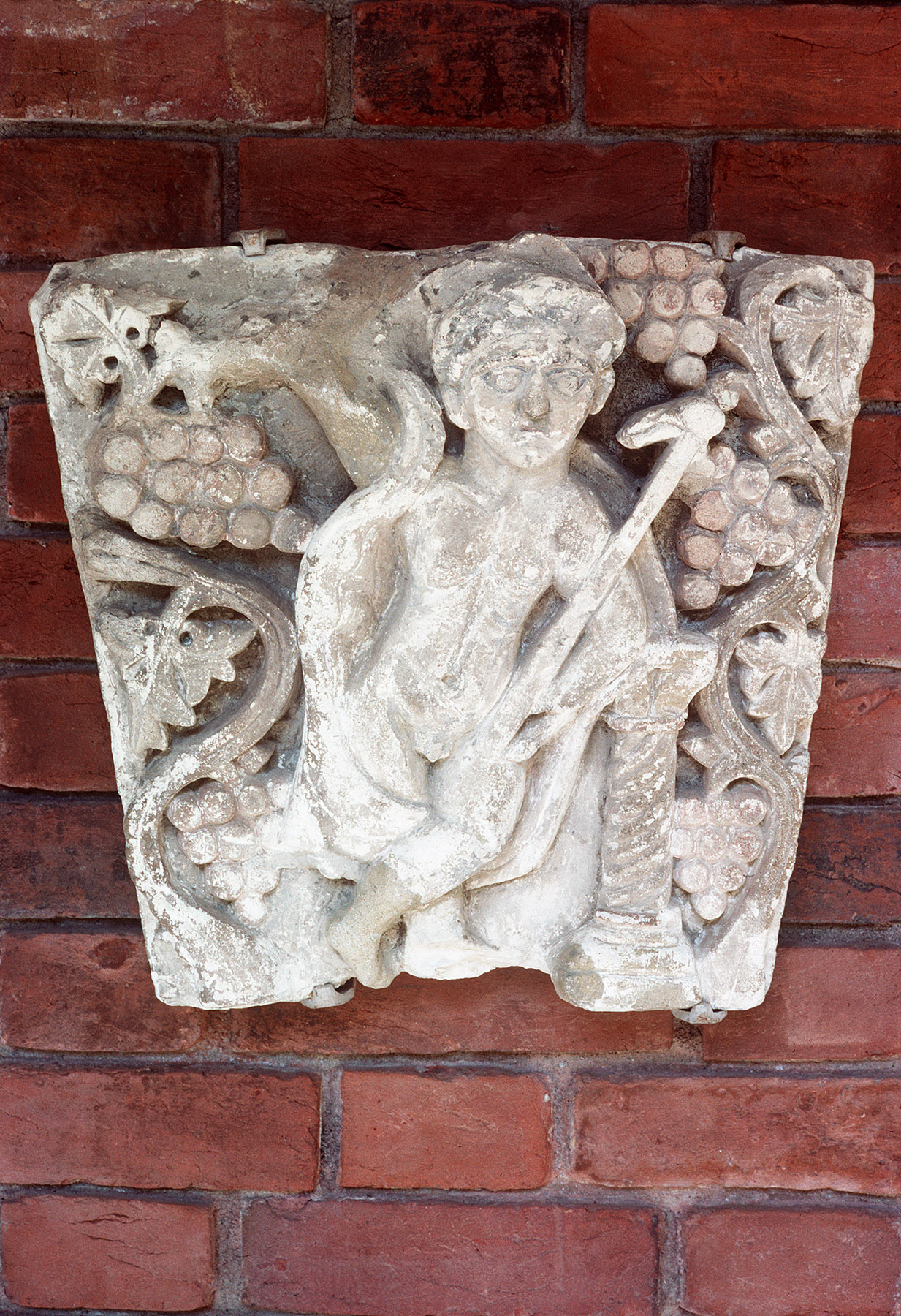
Keystone with Dionysos, late 5th-6th century, Early Byzantine, Egypt, limestone, 35 x 38.5 x 12.5cm, Washington D.C., Dumbarton Oaks.
Description
Museum Description: “The fragment (BZ.1940.60) showing Dionysus, nude except for a mantle, with legs crossed and his right arm placed over his head—now broken off—leaning on a spirally fluted pedestal, served as a keystone of an arch whose span would have been approximately 2 m.
The remarkable depth of the sharply carved design, which creates a strong contrast of light and shadow, and the combination of symmetry and repetition characterize a wellknown group of limestone sculpture that has been excavated from a rich early Byzantine site in Middle Egypt called Oxyrhynchus (modern Behnesa).
Closely related to two fragments with a vine scroll ornament in this collection (BZ.1935.12 and BZ.1940.59) which undoubtedly formed part of the same or similar arches with an inner span of about 2.5 m.
There has been much debate and confusion about the date and context of these architectural fragments. In the beginning of the twentieth century, they were interpreted as parts of church decorations. The excavations, however, were not systematically undertaken and documented and there is little exclusively Christian about these carvings. Revisions in the chronology of Egyptian-Coptic sculpture have led to a shift in opinion.
We now know that these sculptural remains were mainly part of tombs and belong to the city’s necropolis. The vine scroll arches may have been the façade of a Christian or a pagan tomb cella or the decoration and setting of a funerary niche. Dionysus in combination with grape vines alludes to the hope of the deceased for a joyful afterlife.”
-G. Bühl
The remarkable depth of the sharply carved design, which creates a strong contrast of light and shadow, and the combination of symmetry and repetition characterize a wellknown group of limestone sculpture that has been excavated from a rich early Byzantine site in Middle Egypt called Oxyrhynchus (modern Behnesa).
Closely related to two fragments with a vine scroll ornament in this collection (BZ.1935.12 and BZ.1940.59) which undoubtedly formed part of the same or similar arches with an inner span of about 2.5 m.
There has been much debate and confusion about the date and context of these architectural fragments. In the beginning of the twentieth century, they were interpreted as parts of church decorations. The excavations, however, were not systematically undertaken and documented and there is little exclusively Christian about these carvings. Revisions in the chronology of Egyptian-Coptic sculpture have led to a shift in opinion.
We now know that these sculptural remains were mainly part of tombs and belong to the city’s necropolis. The vine scroll arches may have been the façade of a Christian or a pagan tomb cella or the decoration and setting of a funerary niche. Dionysus in combination with grape vines alludes to the hope of the deceased for a joyful afterlife.”
-G. Bühl
Source
http://museum.doaks.org/objects-1/info/27197
Publisher
Dumbarton Oaks BZ.1940.60
Files
Collection
Citation
“Keystone with Dionysos,” HAA Image Hosting, accessed September 28, 2026, https://haaimagehosting.omeka.fas.harvard.edu/items/show/332.
Embed
Copy the code below into your web page