Browse Items (972 total)
Sort by:
Synagogue at Capernaum
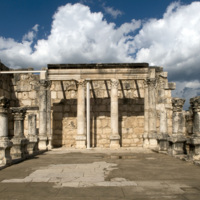
Although there is a synagogue at Capernaum mentioned in the Gospel of Luke, the ruins of a synagogue visible today date to the 4th or 5th century CE. There is, however, some evidence of an earlier structure beneath its foundations, and some scholars…
Glass Cup
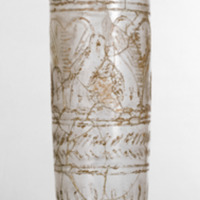
This ornamental cup bears a Greek inscription reading: “and for years to come!” It was found in Brsljin, Slovenia.
Byzantine Church at Petra
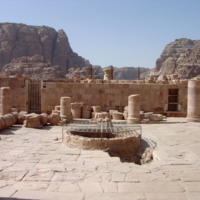
The so-called Byzantine Church in Petra is one of three Byzantine Churches in the city, the other two are the Ridge Church (also called the Red Church) and the Blue Chapel. It is generally The Byzantine Church is thought to have been built in the…
Adam and Eve from the Catacomb of Marcellinus and Peter
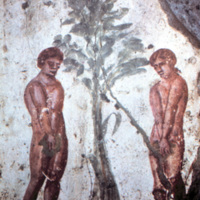
This fresco of Adam and Eve in the garden is instantly recognizable to anyone who is familiar with the scene from later centuries of Christian art. Within the catacomb, there is a mixture of pagan (including a representation of Orpheus playing a…
Floor Mosaic with Bust of Apolausis (“Enjoyment”)
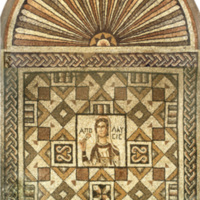
Museum Descprition: “Apolausis, the personification of enjoyment, welcomes visitors to Dumbarton Oaks as she has done since its doors opened to the public in 1941. The floor had been discovered just a few years before in a bath building located…
Missorium of Theodosius I
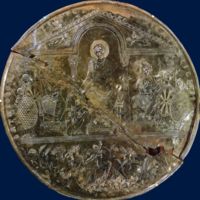
Missorium of Theodosius I, 388, Roman, silver and silver gilt, diam: 74 cm, weight: 15.35 kg, Madrid, Academia de la Historia.
This silver dish, most likely made in Constantinople, was meant to celebrate the tenth anniversary of Theodosius I’s…
This silver dish, most likely made in Constantinople, was meant to celebrate the tenth anniversary of Theodosius I’s…
Gold Bar
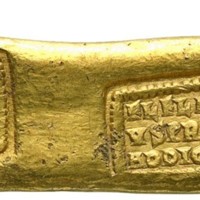
This gold bar is one of fifteen (all dating to the 4th century) that were found in Romania in the late 19th century. The form makes it more easily transportable, and it most likely would have been brought to a mint where it would have been melted…
Portrait of the Four Tetrarchs
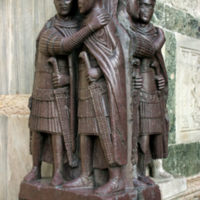
This sculpture group depicts the Four Tetrarchs, the four rulers of the Roman Empire as established by Diocletian. The rulers were divided into two groups: the augusti (Diocletian and Maximian) and the caesares (Galerius and Constantius I). There is…
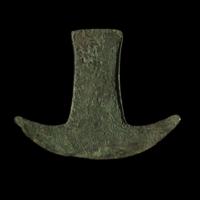
Manuscript folio, 1341
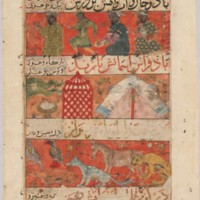
Folio from a manuscript of Mu'nis al-ahrar fi daqa 'iq al-ash'ar (The Free Men's Companion to the Subtleties of Poems) by Muhammad ibn Badr al-Din Jajarmi: Treasurer, money changer, courier and jeweler; tent, pavilion, drum, and banner; lion, onager,…