Synagogue at Capernaum
Dublin Core
Title
Synagogue at Capernaum
Subject
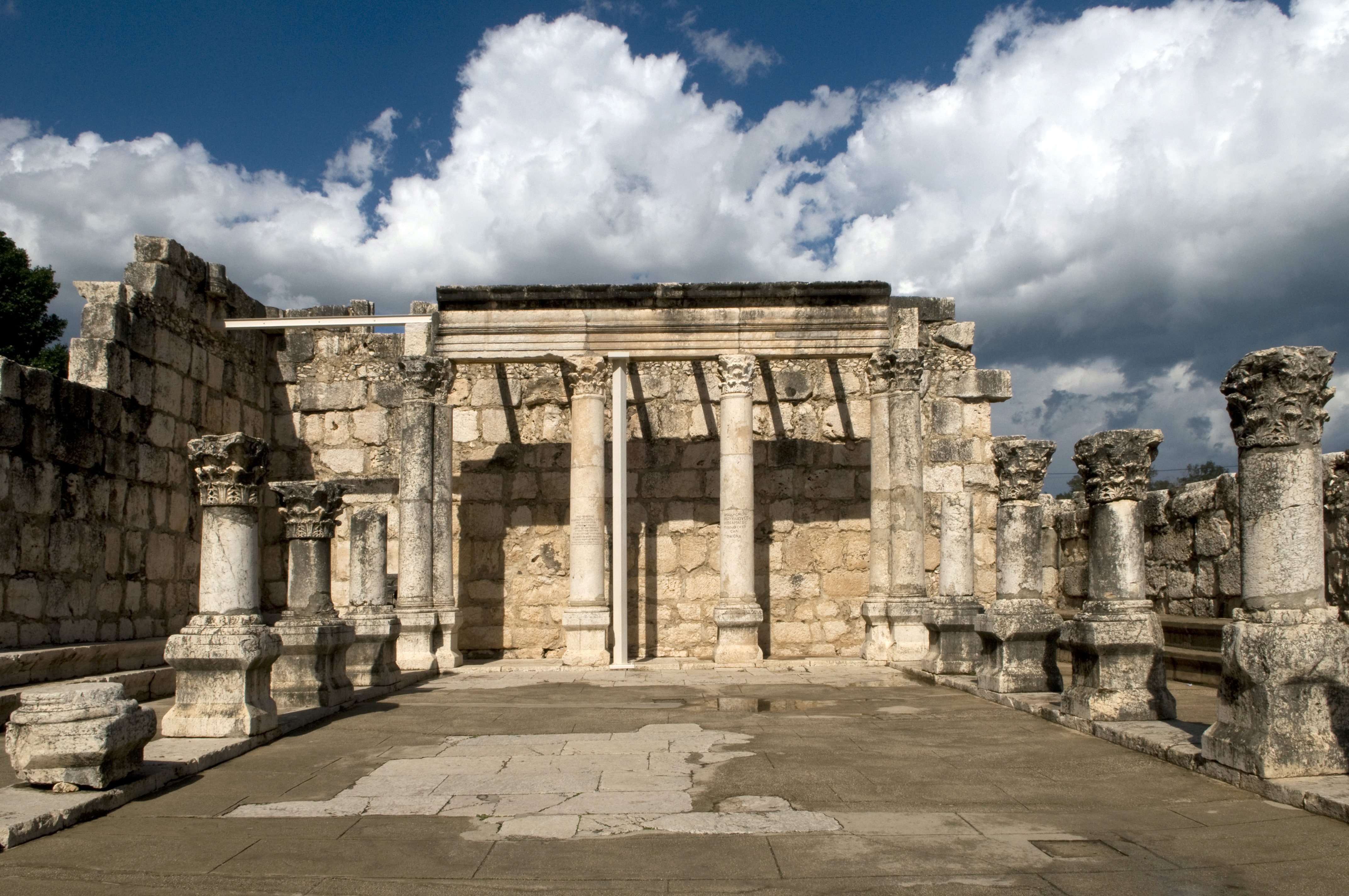
Synagogue at Capernaum, 4th-5th century, Roman, white calcareous stone, Israel.
Description
Although there is a synagogue at Capernaum mentioned in the Gospel of Luke, the ruins of a synagogue visible today date to the 4th or 5th century CE. There is, however, some evidence of an earlier structure beneath its foundations, and some scholars have suggested that these are the remains of the 1st-century building. The 4th-century synagogue is comprised of four sections: a columnated prayer hall that measured 20.5 x 18.5 m, an eastern courtyard (20.5 x 11m), a southern balustrade (4m wide), and a small room at the northwest end of the building. Scholarly opinion is dividing regarding the possibility of there having once been a second floor with a prayer space reserved for women. The synagogue was decorated with carved figurative motifs, Jewish motifs (such as a menorah with a ram’s horn on one capital), as well as floral motifs.
An inscription in Greek reads (in translation): Herod son of Mo[ni]mos and Justus his son,
together with (his) children, erected this column.
An inscription in Aramaic reads (in translation): Halfu son of Zebida, the son of Yohanan, made this column. May he be blessed.
An inscription in Greek reads (in translation): Herod son of Mo[ni]mos and Justus his son,
together with (his) children, erected this column.
An inscription in Aramaic reads (in translation): Halfu son of Zebida, the son of Yohanan, made this column. May he be blessed.
Source
https://mfa.gov.il/mfa/israelexperience/history/pages/capernaum%20-%20city%20of%20jesus%20and%20its%20jewish%20synagogue.aspx
Files
Collection
Citation
“Synagogue at Capernaum,” HAA Image Hosting, accessed September 17, 2026, https://haaimagehosting.omeka.fas.harvard.edu/items/show/320.
Embed
Copy the code below into your web page