Floor Mosaic with Bust of Apolausis (“Enjoyment”)
Dublin Core
Title
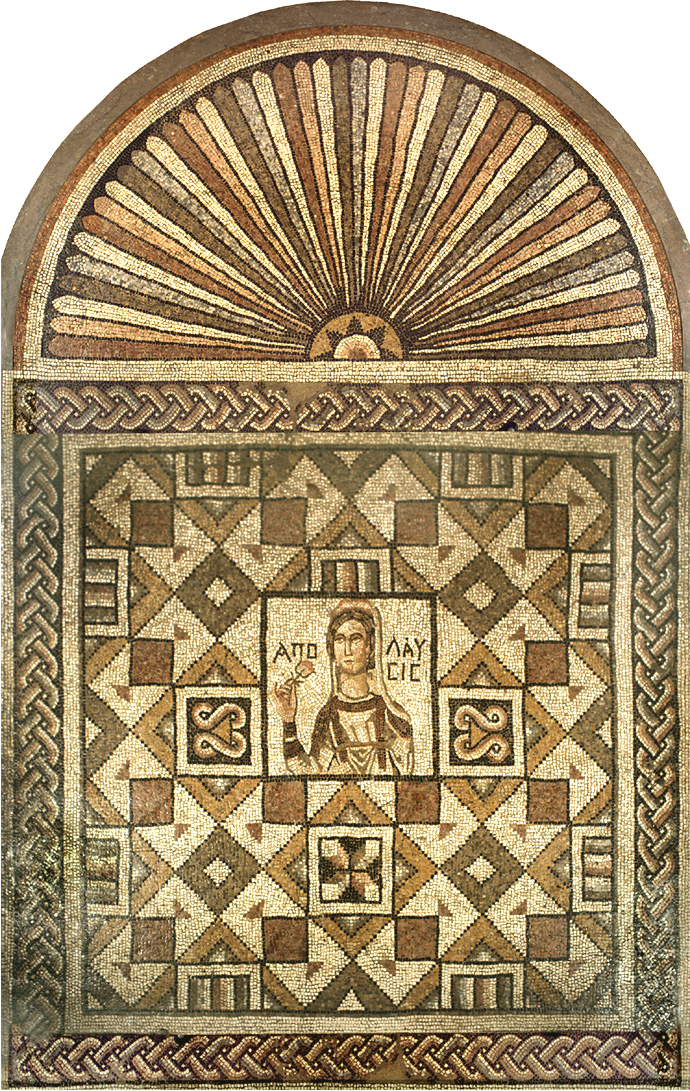
Floor Mosaic with Bust of Apolausis (“Enjoyment”)
Subject
Floor Mosaic with Bust of Apolausis (“Enjoyment”), Late 4th-early 5th century, Early Byzantine, mosaic on mortar, Washington D.C., Dumbarton Oaks.
Description
Museum Descprition: “Apolausis, the personification of enjoyment, welcomes visitors to Dumbarton Oaks as she has done since its doors opened to the public in 1941. The floor had been discovered just a few years before in a bath building located approximately nine kilometers northeast of ancient Antioch, where excavations had been under way since 1932. The Committee for the Excavation of Antioch and Vicinity, led by Princeton University, was supported by several universities and museums and, starting in 1936, Mr. and Mrs. Bliss. In return for their contributions and with the consent of the Syrian Ministry of Antiquities, the donors to the excavation project received archaeological finds. It is for this reason that all of the floor mosaics at Dumbarton Oaks are from Antioch and nearby sites. The cordial offer to enjoy the amenities of the bath is made by the delicately veiled figure of “Enjoyment” holding up a rose. She graced the pavement of the cold-water pool which, along with other rooms built to provide the tepid and hot-water pools, was found in most Roman bath installations. Based on its location at Toprak-en Narlidja, some distance from Antioch, the building probably served as a public bath for a number of nearby villa-farms.
Apolausis is framed by multicolored patterns and colors that are repeated on both a square and diagonal grid, creating a dynamic surround in contrast to the calm figure with whom the entering viewer immediately establishes contact. The fan-shaped section of the floor corresponded to the original end of the room.”
-S. Zwirn
Apolausis is framed by multicolored patterns and colors that are repeated on both a square and diagonal grid, creating a dynamic surround in contrast to the calm figure with whom the entering viewer immediately establishes contact. The fan-shaped section of the floor corresponded to the original end of the room.”
-S. Zwirn
Source
http://museum.doaks.org/objects-1/info/30420
Publisher
Dumbarton Oaks BZ.1938.72
Files
Collection
Citation
“Floor Mosaic with Bust of Apolausis (“Enjoyment”),” HAA Image Hosting, accessed September 24, 2026, https://haaimagehosting.omeka.fas.harvard.edu/items/show/316.
Embed
Copy the code below into your web page