Browse Items (13 total)
- Collection: Final Late Antiquity Mirador
Sort by:
Lampstand or Candlestick
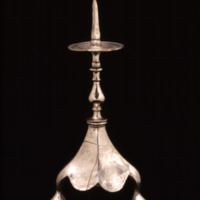
Excavated in Antioch in a fragmentary state and restored, this lampstand or candlestick rests upon three feet, which support a flaring base of petal-shaped aprons. Above, a baluster topped with a disk ends with a four-sided spike known as a pricket.…
Openwork Lamp with Openwork Inscription
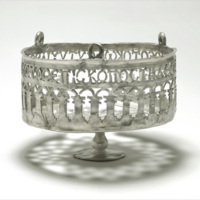
The Sion Treasure (BZ.1963.36.1-3,11 and BZ.1965.1.1,5,12) is an extensive and varied group of liturgical objects and church furnishings discovered in the early 1960s in southern Turkey. A significant part of this treasure is in Dumbarton Oaks, while…
Lamp Handle with Dolphins
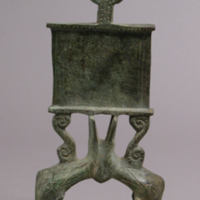
A pair of dolphins use their tails to support the handle’s rectangular plaque. Their heads would have been attached to a now-lost base.
Round flat hanging lamps, or polycandela, were lit by oil-filled glass vessels hung from the round holes in…
Round flat hanging lamps, or polycandela, were lit by oil-filled glass vessels hung from the round holes in…
Terracotta oil lamp
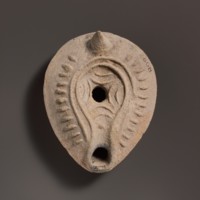
Vessberg Type 19. Mold-made. Applied conical handle. Sharply carinated, pear-shaped body. Discus: square pattern comprising two curved, raised lines on each side around central filling hole; channel to wick hole, with a raised dot above; around…
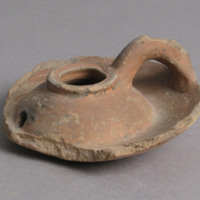
Lamp with Christ Trampling the Beasts
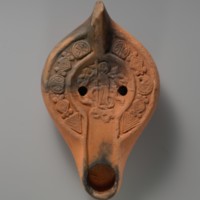
Small earthenware lamps, made from double molds, were the most commonly used source of light in North Africa during the early Byzantine period. A wick produced from plant fiber or linen fabric was placed in a reservoir filled with oil, generally…
Glass Jug
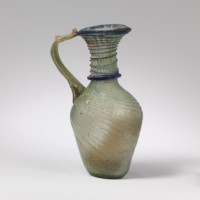
Translucent blue green; handle in same color; trails in translucent cobalt blue.
Plain rim, with downward flange on one side; flaring mouth; cylindrical neck, expanding slightly downwards; slanting, rounded shoulder; funnel-shaped body; thick bottom…
Plain rim, with downward flange on one side; flaring mouth; cylindrical neck, expanding slightly downwards; slanting, rounded shoulder; funnel-shaped body; thick bottom…
Glass jar with marvered trails
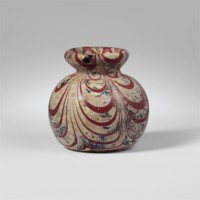
Uncertain translucent color; trail and pontil pad in opaque brownish red.
Thick, outsplayed rim, folded over, in, and pressed down into mouth; very short, concave, cylindrical neck; globular body; kick in bottom, with traces of pontil…
Thick, outsplayed rim, folded over, in, and pressed down into mouth; very short, concave, cylindrical neck; globular body; kick in bottom, with traces of pontil…
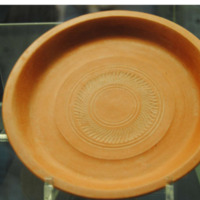
Dish/Bowl
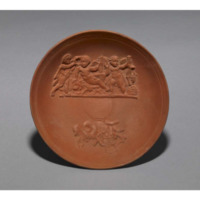
Pottery: African Red Slip Ware dish or bowl with appliqué decoration. The larger scene shows a group of cupids. The central cupid reclines and seems to be mimicking Hercules, while the others make offerings to him of a garland and a kid. The smaller…