Openwork Lamp with Openwork Inscription
Dublin Core
Title
Openwork Lamp with Openwork Inscription
Subject
a. Early Byzantine c. mid 6th century
b. 10.3 x 15.5 cm, silver
c. Dumbarton Oaks, BZ.1965.1.12
b. 10.3 x 15.5 cm, silver
c. Dumbarton Oaks, BZ.1965.1.12
Description
The Sion Treasure (BZ.1963.36.1-3,11 and BZ.1965.1.1,5,12) is an extensive and varied group of liturgical objects and church furnishings discovered in the early 1960s in southern Turkey. A significant part of this treasure is in Dumbarton Oaks, while much of it is housed in the Antalya Museum, with a few pieces in private collections. The treasure’s name derives from the niello inscription on an oblong polycandelon mentioning “Holy Sion,” possibly the church or the monastery for which the objects were made. Many Sion Treasure items are inscribed for a Bishop Eutychianos, who is otherwise unknown. Several other individuals are named, but they, too, are unknown among historical sources. Many objects are unique—for example, a cross-shaped polycandelon and a peacock censer. Almost all the objects in the treasure are of exceptionally high quality, and many were in excellent condition when they were found, like the patens. Some pieces, however, were bent or crushed, suggesting that they were going to be melted down and their metal reused. If, as is supposed, the treasure was buried during the early seventh century, when Sasanian invasions were followed by Arab incursions, the Byzantine imperial authorities most likely were calling in church silver to mint coins in order to pay the wages of the emperor’s army.
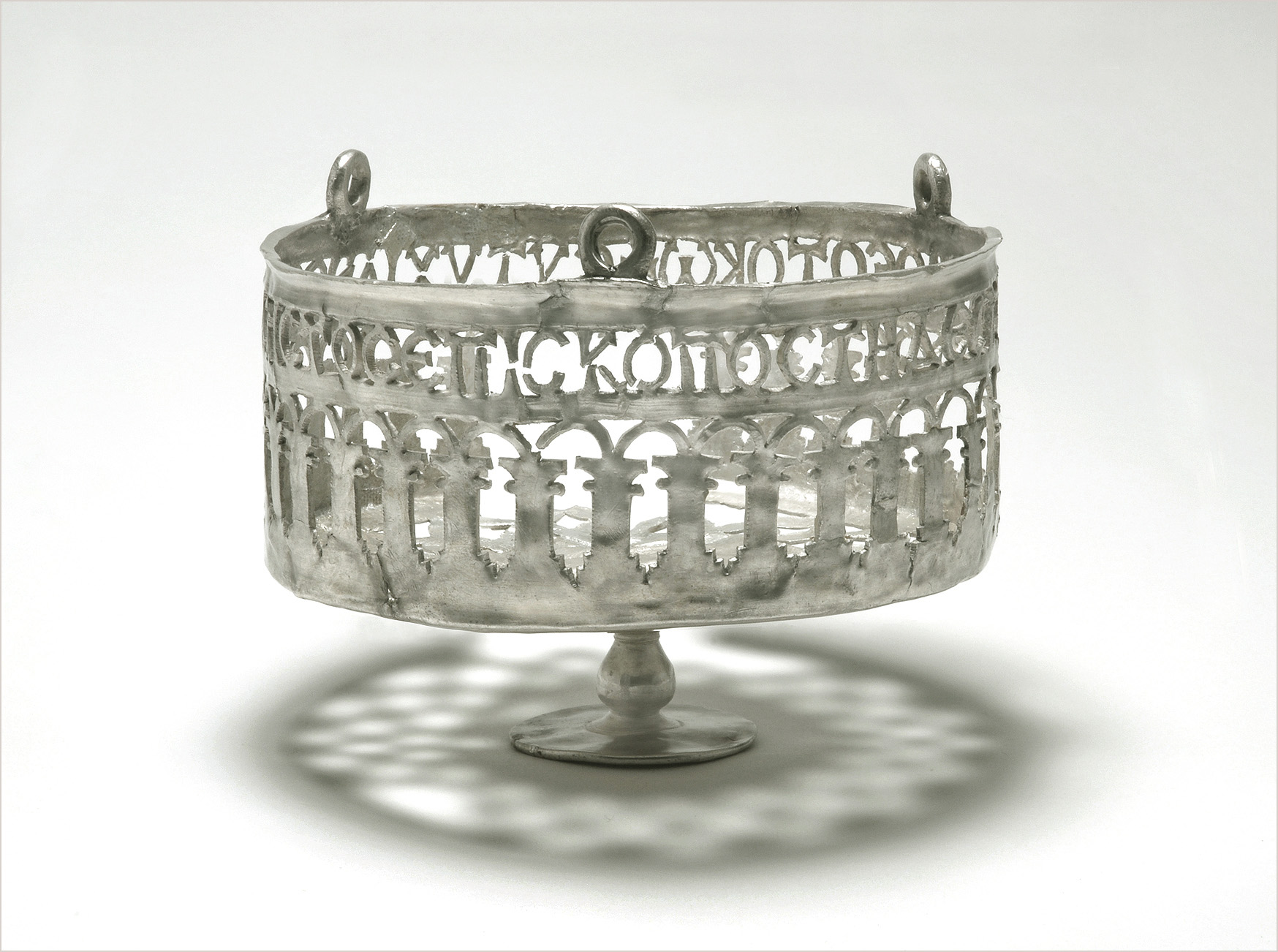
The openwork silver lamps in the Sion Treasure are among its most extraordinary artistic contributions to the history and craft of liturgical arts. This unusual cylindrical lamp has an openwork cut-out inscription over a horseshoe arcade, with a criss-cross openwork pattern on its flat bottom. The oil and burning wick floating on water were originally held in a glass liner that would have been blown directly into the silver container. Whether the lamp was standing or suspended from chains, light would have streamed out of it in all directions through its multiple openwork patterns.
Eutychianos, the major donor of the Sion Treasure, recorded his humility and, incidentally, his pride by including his name in the formula of offering on the lamp: “Eutychianos, most humble bishop, [offers this] to [our] Lady, the Mother of God."
- S. Zwirn
The openwork silver lamps in the Sion Treasure are among its most extraordinary artistic contributions to the history and craft of liturgical arts. This unusual cylindrical lamp has an openwork cut-out inscription over a horseshoe arcade, with a criss-cross openwork pattern on its flat bottom. The oil and burning wick floating on water were originally held in a glass liner that would have been blown directly into the silver container. Whether the lamp was standing or suspended from chains, light would have streamed out of it in all directions through its multiple openwork patterns.
Eutychianos, the major donor of the Sion Treasure, recorded his humility and, incidentally, his pride by including his name in the formula of offering on the lamp: “Eutychianos, most humble bishop, [offers this] to [our] Lady, the Mother of God."
- S. Zwirn
Files
Collection
Citation
“Openwork Lamp with Openwork Inscription,” HAA Image Hosting, accessed August 22, 2026, https://haaimagehosting.omeka.fas.harvard.edu/items/show/1479.
Embed
Copy the code below into your web page