Browse Items (20 total)
- Collection: Late Antiquity, Seminar 2
Sort by:
The Meeting of Leo I and Attila
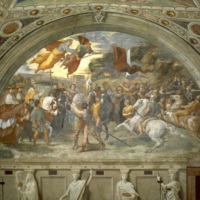
Museum Description: “The encounter between Leo the Great and Attila is the last fresco painted in this room. It was completed after the death of Julius II (pontiff from 1503 to 1513), during the pontificate of his successor Leo X (pontiff from 1513…
Synagogue at Capernaum
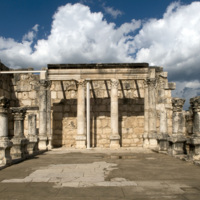
Although there is a synagogue at Capernaum mentioned in the Gospel of Luke, the ruins of a synagogue visible today date to the 4th or 5th century CE. There is, however, some evidence of an earlier structure beneath its foundations, and some scholars…
Solidus of Constantine I
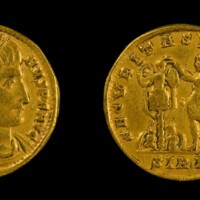
Obverse Bust of Constantine to r., laureate, draped and cuirassed
Inscription: CONSTANTINVS P F AVG
CONSTANTINVS P[IVS] F[ELIX] AVG[VSTUS]
Constantine Dutiful and Wise Augustus
Reverse Emperor standing crowning trophy
Inscription:…
Inscription: CONSTANTINVS P F AVG
CONSTANTINVS P[IVS] F[ELIX] AVG[VSTUS]
Constantine Dutiful and Wise Augustus
Reverse Emperor standing crowning trophy
Inscription:…
Silver Ewer
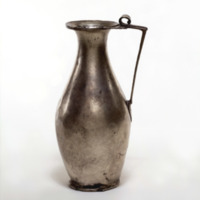
Museum Desciprtion: “This silver ewer reflects the good life that could be found in a household in Daphne, the wealthy suburb of the great commercial city of Antioch. In one of the villas, the ewer was discovered purposely buried together with three…
Roundel
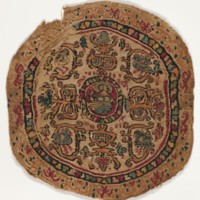
Museum Description: “Tapestry woven roundel (orbiculus). The small medallion at its center contains a female figure, likely a beneficent personification, with a green nimbus against a bright red background. Her breasts are distinguished in yellow…
Portrait of the Four Tetrarchs
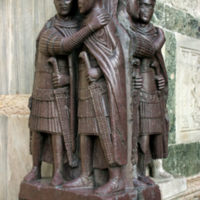
This sculpture group depicts the Four Tetrarchs, the four rulers of the Roman Empire as established by Diocletian. The rulers were divided into two groups: the augusti (Diocletian and Maximian) and the caesares (Galerius and Constantius I). There is…
One ounce Weight with Busts of Two Emperors
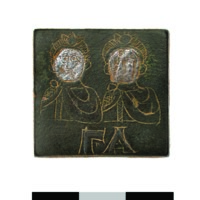
Museum Description: “Rectangular Weight with Busts of Two Emperors, a Gamma and an Alpha (1 oz.)”
Missorium of Theodosius I
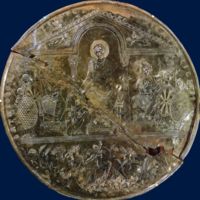
Missorium of Theodosius I, 388, Roman, silver and silver gilt, diam: 74 cm, weight: 15.35 kg, Madrid, Academia de la Historia.
This silver dish, most likely made in Constantinople, was meant to celebrate the tenth anniversary of Theodosius I’s…
This silver dish, most likely made in Constantinople, was meant to celebrate the tenth anniversary of Theodosius I’s…
Keystone with Dionysos
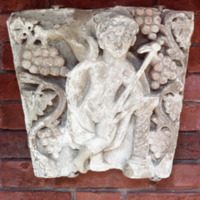
Museum Description: “The fragment (BZ.1940.60) showing Dionysus, nude except for a mantle, with legs crossed and his right arm placed over his head—now broken off—leaning on a spirally fluted pedestal, served as a keystone of an arch whose span would…
Griffin’s Head Lamp
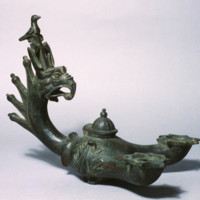
Museum Description: “Noteworthy for its imposing size, this lamp is also remarkable for its combination of pagan and Christian imagery. The handle is an elegantly articulated griffin’s head, which derives from pagan mythology, while the cross, symbol…