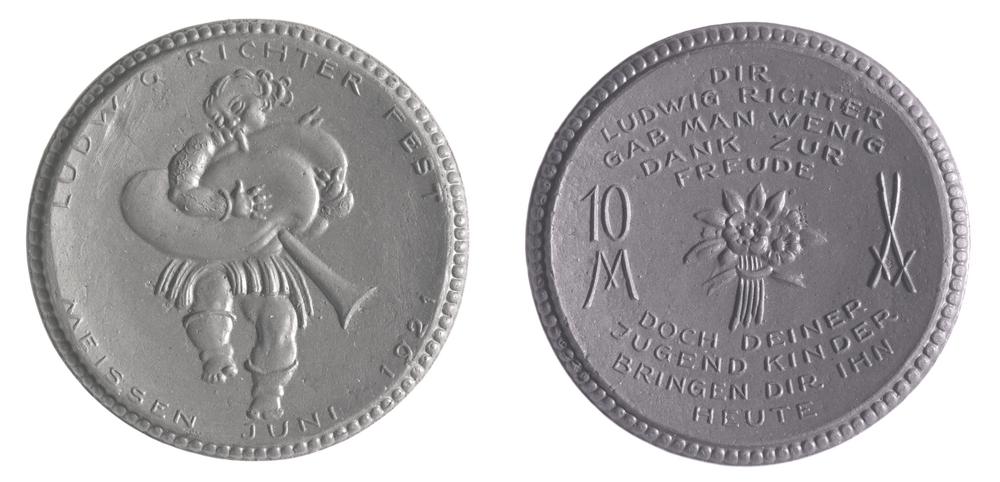
Emergency money. Porcelain coin for 10 marks from Meissen.
Dublin Core
Title
Emergency money. Porcelain coin for 10 marks from Meissen.
Subject
Emergency money. Porcelain coin for 10 marks from Meissen, 1921
Description
This is a red stoneware (Böttgersteinzeug) coin minted by the celebrated ceramic factory at Meissen in Germany. Meissen had produced its first porcelain medallion in 1710, shortly after the factory was established. Regular production of German porcelain coins as currency for a variety of towns, cities, and regains (emergency money and donation coins) began at the end of 1920 and in the first months of 1921, at the beginning of a period of hyperinflation following the end of World War I.
Notgeld (German for "emergency money" or "necessity money") was special money issued primarily in Germany and Austria to deal with economic crisis situations such as a shortage of small change or hyperinflation. It was not issued by the central bank (Reichsbank) but by various other institutions such as town savings banks, municipalities, private and state-owned firms. It was therefore not legal tender, but rather a mutually-accepted means of payment in a particular locale or site. Around the end of the 19th century one of the porcelain factories in the town of Meissen started making small medals out of hard terra cotta and porcelain. They proved popular and a series of several hundred items was produced over a period of about 60 years.
Notgeld (German for "emergency money" or "necessity money") was special money issued primarily in Germany and Austria to deal with economic crisis situations such as a shortage of small change or hyperinflation. It was not issued by the central bank (Reichsbank) but by various other institutions such as town savings banks, municipalities, private and state-owned firms. It was therefore not legal tender, but rather a mutually-accepted means of payment in a particular locale or site. Around the end of the 19th century one of the porcelain factories in the town of Meissen started making small medals out of hard terra cotta and porcelain. They proved popular and a series of several hundred items was produced over a period of about 60 years.
Files
Collection
Citation
“Emergency money. Porcelain coin for 10 marks from Meissen.,” HAA Image Hosting, accessed September 27, 2026, https://haaimagehosting.omeka.fas.harvard.edu/items/show/1273.
Embed
Copy the code below into your web page