Browse Items (972 total)
Sort by:
Adam and Eve from the Catacomb of Marcellinus and Peter
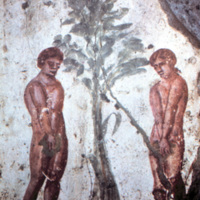
This fresco of Adam and Eve in the garden is instantly recognizable to anyone who is familiar with the scene from later centuries of Christian art. Within the catacomb, there is a mixture of pagan (including a representation of Orpheus playing a…
Byzantine Church at Petra
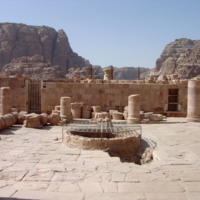
The so-called Byzantine Church in Petra is one of three Byzantine Churches in the city, the other two are the Ridge Church (also called the Red Church) and the Blue Chapel. It is generally The Byzantine Church is thought to have been built in the…
Glass Cup
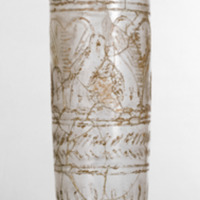
This ornamental cup bears a Greek inscription reading: “and for years to come!” It was found in Brsljin, Slovenia.
Synagogue at Capernaum
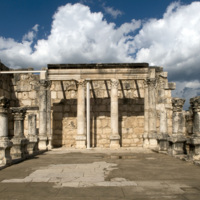
Although there is a synagogue at Capernaum mentioned in the Gospel of Luke, the ruins of a synagogue visible today date to the 4th or 5th century CE. There is, however, some evidence of an earlier structure beneath its foundations, and some scholars…
The Meeting of Leo I and Attila
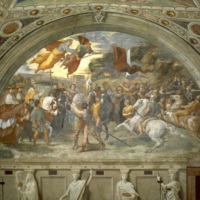
Museum Description: “The encounter between Leo the Great and Attila is the last fresco painted in this room. It was completed after the death of Julius II (pontiff from 1503 to 1513), during the pontificate of his successor Leo X (pontiff from 1513…
One ounce Weight with Busts of Two Emperors
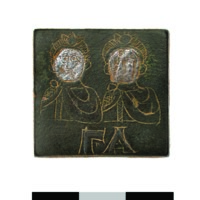
Museum Description: “Rectangular Weight with Busts of Two Emperors, a Gamma and an Alpha (1 oz.)”
Forgery of a Gold Semissis of Anastasios I

Obverse: Bust of Anastasios I facing right with diadem, cuirass, and paludamentum.
DNANASTA-SIVSPPAVC
D[OMINUS NOSTER] ANASTASIVS P[ER]P[ETEUUS] AVC[VSTVS]
Our Lord, Anastasios, Perpetual Emperor
Reverse: Victory, nude to the waist,…
DNANASTA-SIVSPPAVC
D[OMINUS NOSTER] ANASTASIVS P[ER]P[ETEUUS] AVC[VSTVS]
Our Lord, Anastasios, Perpetual Emperor
Reverse: Victory, nude to the waist,…
Gold Chain with Fifty-Two Pendants

This gold necklace was found in Szilágysomlyó (modern-day Simleu-Silvaniei, Romania) in 1797 by two shepherd boys. The central pendant is smoky quartz. The other 51 pendants depict various tools and weapons in miniature as well as a man in a canoe.…
Galerius attacking Narseh, detail from the Arch of Galerius,

The Arch of Galerius was built between 298 and 299 and dedicated in 303 to celebrate his victory at the Battle of Satala and the capture of Ctesiphon. In this detail, Galerius (at left) is shown attacking Narseh (or Narses, at right). Narseh was the…
Fragment of the Edict on Maximum Prices (in Greek)

Issued by Diocletian in 301, the Edict on Maximum prices gives the maximum prices for more than 1,200 products, raw materials, labor, services, modes of transport, animals, and for enslaved peoples. Fresh green animal fodder could be purchased for 1…