Browse Items (972 total)
Sort by:
Fragment of a Chalice from near Vindolanda
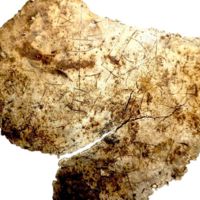
This is a fragment from a chalice found from excavations at a 6th Century church near Vindolanda, a Roman Fort close to Hadrian’s wall. The chalice itself dates to around the 5th century. The fragment is covered in graffiti, which has a negative…
Fragment of a Marble Tomb Relief with Christ Giving the Law
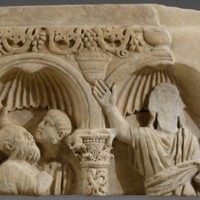
Museum wall text: “The authority of the Christian church grew rapidly with emperor Constantine's recognition of the faith as a legal religion within the Roman Empire in 313. Increasingly the most powerful centers of the church were the old imperial…
Fragment of a Staff
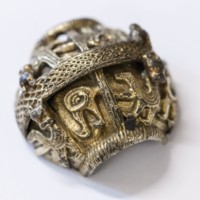
This is a fragment of a staff, possibly a crozier, found in a Viking grave in Norway. The fragment was a taken in a raid and then used as jewelry by the Vikings, broken off from a main staff. It is estimated to date from Northern Britain in the late…
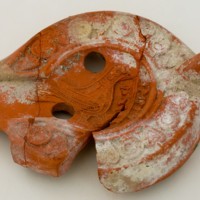
Fragment of the Edict on Maximum Prices (in Greek)

Issued by Diocletian in 301, the Edict on Maximum prices gives the maximum prices for more than 1,200 products, raw materials, labor, services, modes of transport, animals, and for enslaved peoples. Fresh green animal fodder could be purchased for 1…
Frankish gold coin pendant with corrugate suspension loop; solidi of King Chlothar II (613-628 AD)
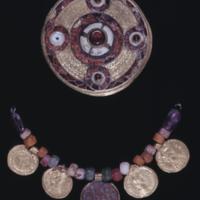
Part of a necklace
The brooch and necklace were found in 1860 in a female burial. There are discrepancies as to the exact contents of the graves in the earliest published sources, but they included an iron weaving batten, a copper-alloy pin, a…
The brooch and necklace were found in 1860 in a female burial. There are discrepancies as to the exact contents of the graves in the earliest published sources, but they included an iron weaving batten, a copper-alloy pin, a…
French Assignat issued on May 23, 1793
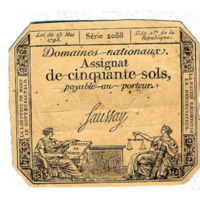
Lower right, Justice, draped, seated left, holding scales in right hand, leaning on parazonium with left arm: to left unidentified allegorical figure, draped, seated right, holding inscribed tablet in both hands with Gallic rooster at feet;…
French Assignat, issued in 1792
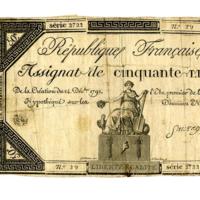
Female allegorical figure Liberty, centre, with Gallic rooster, olive branch and musical instrument (?), seated on stone block showing two parazoniums and the hat of Liberty; decorative border. (obverse)
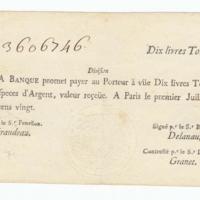
Fresco
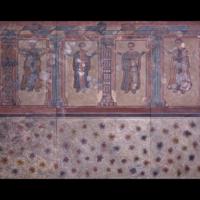
Museum Description: “This wall painting was found at Lullingstone, Kent, in the Darenth valley, when the remains of a Roman villa were excavated in 1949. The villa had been built in the late first century AD, and altered and extended several times in…