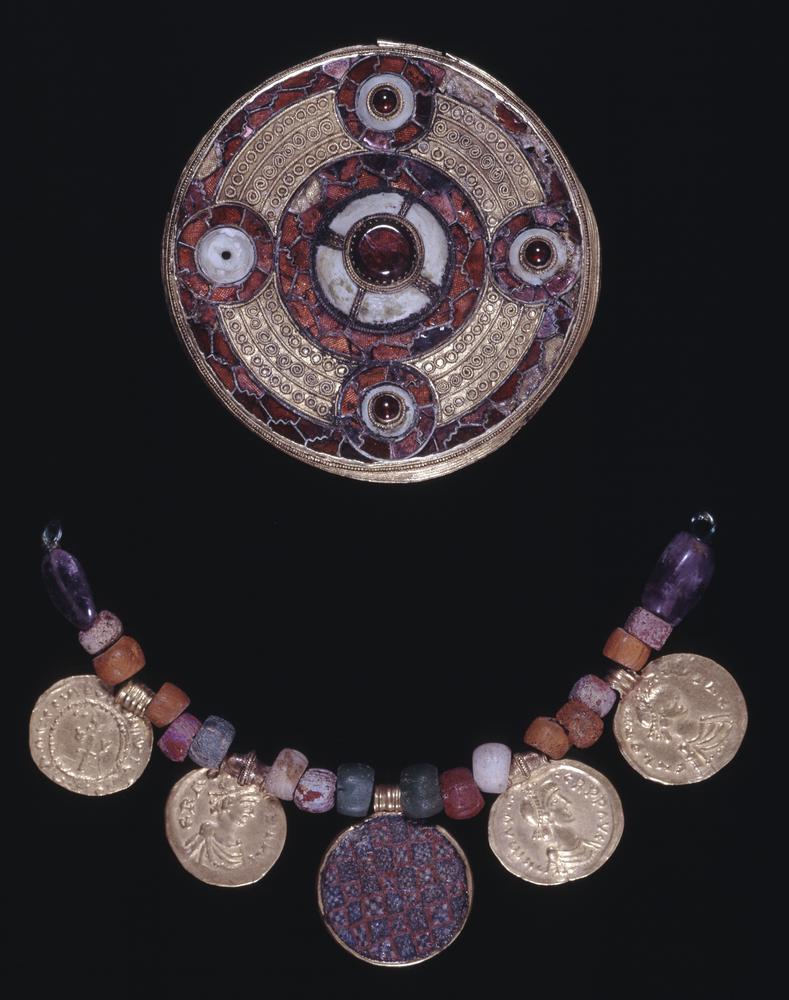
Frankish gold coin pendant with corrugate suspension loop; solidi of King Chlothar II (613-628 AD)
Dublin Core
Title
Frankish gold coin pendant with corrugate suspension loop; solidi of King Chlothar II (613-628 AD)
Subject
Frankish gold coin pendant with corrugate suspension loop; solidi of King Chlothar II (613-628 AD), early 7th c, gold, 2 cm diameter, British Museum
Description
Part of a necklace
The brooch and necklace were found in 1860 in a female burial. There are discrepancies as to the exact contents of the graves in the earliest published sources, but they included an iron weaving batten, a copper-alloy pin, a purse mount, an iron knife, and a copper-alloy Byzantine bowl, a luxury item imported from the eastern Mediterranean.
The closest parallels to the piece, all from Kent, are one presumed to be from Priory Hill, Dover, and a piece from Gilton (Avent 1975, nos 174, 175). A third brooch from Aylesford has lost all its inlays (ibid., no. 173), but all three share the same cruciform arrangement of the bosses, and inset filigree panels between two cloisonné bands. The form of the pin and catchplate on the Sarre brooch also links it to the Kingston brooch (Cat. No. 32a; National Museums and Galleries on Merseyside, Liverpool Museum, inv. no. M 6226), but with its copper-alloy cloisons and coarse filigree it is by no means as technically accomplished.
On the basis of the numismatic evidence, the coins on the necklace were probably assembled about 615, so the objects cannot have been buried before that date. It is most likely that they were deposited during the second or third decade of the seventh century.
The brooch and necklace were found in 1860 in a female burial. There are discrepancies as to the exact contents of the graves in the earliest published sources, but they included an iron weaving batten, a copper-alloy pin, a purse mount, an iron knife, and a copper-alloy Byzantine bowl, a luxury item imported from the eastern Mediterranean.
The closest parallels to the piece, all from Kent, are one presumed to be from Priory Hill, Dover, and a piece from Gilton (Avent 1975, nos 174, 175). A third brooch from Aylesford has lost all its inlays (ibid., no. 173), but all three share the same cruciform arrangement of the bosses, and inset filigree panels between two cloisonné bands. The form of the pin and catchplate on the Sarre brooch also links it to the Kingston brooch (Cat. No. 32a; National Museums and Galleries on Merseyside, Liverpool Museum, inv. no. M 6226), but with its copper-alloy cloisons and coarse filigree it is by no means as technically accomplished.
On the basis of the numismatic evidence, the coins on the necklace were probably assembled about 615, so the objects cannot have been buried before that date. It is most likely that they were deposited during the second or third decade of the seventh century.
Files
Collection
Citation
“Frankish gold coin pendant with corrugate suspension loop; solidi of King Chlothar II (613-628 AD),” HAA Image Hosting, accessed August 27, 2026, https://haaimagehosting.omeka.fas.harvard.edu/items/show/1232.
Embed
Copy the code below into your web page