Browse Items (19 total)
- Collection: Late Antiquity, Seminar 3
Sort by:
Achilles sacrificing to Zeus from the Ambrosian Iliad
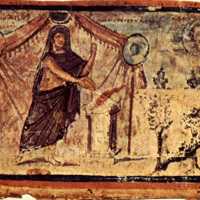
The Ambrosian Iliad, also called the Ilias Picta, is the oldest (and only ancient) surviving illustrated manuscript of Homer’s Iliad. Along with the Vatican Vergil (see Module 1) and the Vergilius Romanus, it is one of three extant examples of…
Articulated Ivory Doll
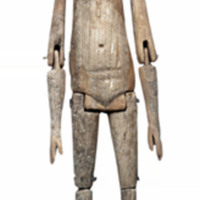
Museum Description: “An ivory doll with articulated arms and legs. Found in the sarcophagus of a young girl in the Early Christian Necropolis of Tarragona.
It would have been part of the grave goods of the girl, who died at the age of five or six.…
It would have been part of the grave goods of the girl, who died at the age of five or six.…
Belt Fitting
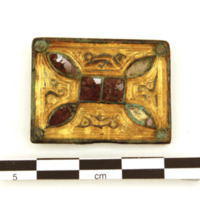
Museum Description: “Gilt copper alloy belt mount, cast: rectangular, inlaid with square and lentoid garnets; and chip-carved Style I animals in angles; rivets in corners.”
Bowl
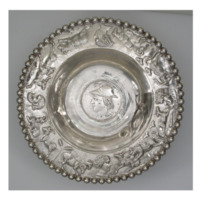
Museum Description: “Silver flanged bowl with beaded rim (66 beads in total) on a circular foot-ring. The basal medallion and the rim are decorated with raised relief made using chasing and engraving techniques. The central medallion, enclosed in a…
Defeat of Radagasio below Fiesole
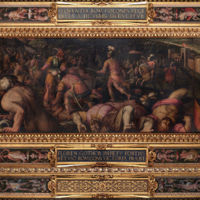
The Gothic king Radagaisus led an invasion of Roman Italy in 405 with his ultimate plan being to sacrifice the (Christian) Roman senators to the gods and then burn the city of Rome to the ground. He was defeated by the general Stilicho and executed.…
Electrotype of ‘The Arras Medallion'
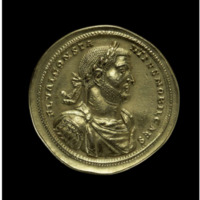
Museum Description: “The reverse scene is visual shorthand to the events described in the panegyric (eulogy) for Constantius, performed during or not long after the celebrations of 1st March AD 297. (Nixon & Rodgers, 1994, 106) The invasion of…
Empress Theodora and Her Retinue
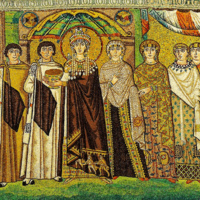
This mosaic depicts Byzantine Empress Theodora and her retinue. Theodora carries the eucharistic chalice. In the companion mosaic of her husband, the Emperor Justinian, he carries the vessel for the eucharistic bread. To her left are two male…
Fresco
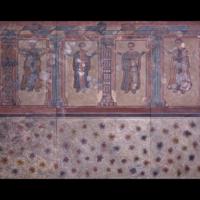
Museum Description: “This wall painting was found at Lullingstone, Kent, in the Darenth valley, when the remains of a Roman villa were excavated in 1949. The villa had been built in the late first century AD, and altered and extended several times in…
Gold Medallion of Constantius I Chlorus
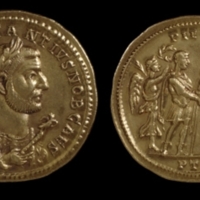
Museum Description: “Britain rejoins the Roman Empire!
In AD 296 Britain was again annexed to the Roman Empire after the ten-year rule of the usurpers Carausius and Allectus. They had governed Britain as self-styled emperors, but were not…
In AD 296 Britain was again annexed to the Roman Empire after the ten-year rule of the usurpers Carausius and Allectus. They had governed Britain as self-styled emperors, but were not…
Mithras Slaying the Bull (Tauroctony) from the London Mithraeum
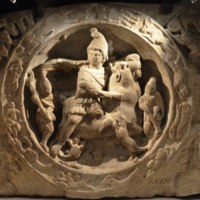
Museum Description: “This marble sculpture is from the Temple of Mithras which once stood in the City. It shows Mithras plunging his dagger into the neck of a bull from whose blood sprang everlasting life. The inscription reads 'Ulpius Silvanus,…