Gold Medallion of Constantius I Chlorus
Dublin Core
Title
Gold Medallion of Constantius I Chlorus
Subject
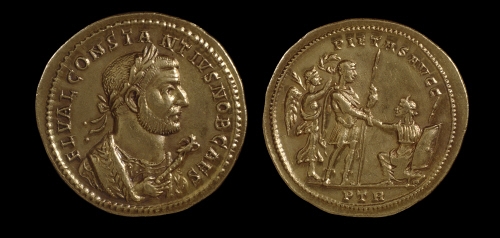
Gold Medallion of Constantius I Chlorus, 297 CE, Roman, Trier, Germany, diam: 34 mm, weight: 26.79g, gold, London, The British Museum.
Description
Museum Description: “Britain rejoins the Roman Empire!
In AD 296 Britain was again annexed to the Roman Empire after the ten-year rule of the usurpers Carausius and Allectus. They had governed Britain as self-styled emperors, but were not recognized as legitimate by the emperor Diocletian and his allies on the Continent.
The leader of the expedition to Britain was Constantius I Chlorus, who was deputy emperor, or Caesar, in the western half of the empire (AD 293-306). This presentation medallion was struck to commemorate the reconquest. On the obverse (front) we see Constantius wearing the conqueror's laurel wreath. On the reverse it shows him raising the personification of Britain from her knees, as her saviour from the supposedly unjust domination of the rebel emperors. A winged figure of the goddess Victory crowns him from behind. Constantius died in York while on campaign in Scotland in AD 306, where his son, Constantine I, 'the Great' (reigned AD 306-37), was proclaimed emperor.”
Obverse: Laureate bust representing Constantius I in consular robes, right, holding scipio (eagle-tipped scepter) in right hand.
FL VAL CONSTANTIVS NOB CAES
FL[AVIVS] VAL[ERIVS] CONSTANTIVS NOB[ILISSIMUS] CAES[AR]
[Marcus] Flavius Valerius Constantius, Most Noble Caesar
Reverse: Constantius standing right, raising Britannia, left, from her knees; Victory standing right, behind emperor, crowning him with a wreath.
PIETAS AVGG PTR
PIETAS AVG[USTORUM] (GG denotes the plural) PTR (Trier mintmark)
Piety [duty, responsibility] of the [two] Emperors
In AD 296 Britain was again annexed to the Roman Empire after the ten-year rule of the usurpers Carausius and Allectus. They had governed Britain as self-styled emperors, but were not recognized as legitimate by the emperor Diocletian and his allies on the Continent.
The leader of the expedition to Britain was Constantius I Chlorus, who was deputy emperor, or Caesar, in the western half of the empire (AD 293-306). This presentation medallion was struck to commemorate the reconquest. On the obverse (front) we see Constantius wearing the conqueror's laurel wreath. On the reverse it shows him raising the personification of Britain from her knees, as her saviour from the supposedly unjust domination of the rebel emperors. A winged figure of the goddess Victory crowns him from behind. Constantius died in York while on campaign in Scotland in AD 306, where his son, Constantine I, 'the Great' (reigned AD 306-37), was proclaimed emperor.”
Obverse: Laureate bust representing Constantius I in consular robes, right, holding scipio (eagle-tipped scepter) in right hand.
FL VAL CONSTANTIVS NOB CAES
FL[AVIVS] VAL[ERIVS] CONSTANTIVS NOB[ILISSIMUS] CAES[AR]
[Marcus] Flavius Valerius Constantius, Most Noble Caesar
Reverse: Constantius standing right, raising Britannia, left, from her knees; Victory standing right, behind emperor, crowning him with a wreath.
PIETAS AVGG PTR
PIETAS AVG[USTORUM] (GG denotes the plural) PTR (Trier mintmark)
Piety [duty, responsibility] of the [two] Emperors
Source
https://www.bmimages.com/preview.asp?image=00030509001
Publisher
The British Museum 1928,0208.1
Files
Collection
Citation
“Gold Medallion of Constantius I Chlorus,” HAA Image Hosting, accessed September 19, 2026, https://haaimagehosting.omeka.fas.harvard.edu/items/show/368.
Embed
Copy the code below into your web page