Browse Items (20 total)
- Collection: Late Antiquity, Seminar 2
Sort by:
Forgery of a Gold Semissis of Anastasios I

Obverse: Bust of Anastasios I facing right with diadem, cuirass, and paludamentum.
DNANASTA-SIVSPPAVC
D[OMINUS NOSTER] ANASTASIVS P[ER]P[ETEUUS] AVC[VSTVS]
Our Lord, Anastasios, Perpetual Emperor
Reverse: Victory, nude to the waist,…
DNANASTA-SIVSPPAVC
D[OMINUS NOSTER] ANASTASIVS P[ER]P[ETEUUS] AVC[VSTVS]
Our Lord, Anastasios, Perpetual Emperor
Reverse: Victory, nude to the waist,…
Gold Chain with Fifty-Two Pendants

This gold necklace was found in Szilágysomlyó (modern-day Simleu-Silvaniei, Romania) in 1797 by two shepherd boys. The central pendant is smoky quartz. The other 51 pendants depict various tools and weapons in miniature as well as a man in a canoe.…
Galerius attacking Narseh, detail from the Arch of Galerius,

The Arch of Galerius was built between 298 and 299 and dedicated in 303 to celebrate his victory at the Battle of Satala and the capture of Ctesiphon. In this detail, Galerius (at left) is shown attacking Narseh (or Narses, at right). Narseh was the…
Fragment of the Edict on Maximum Prices (in Greek)

Issued by Diocletian in 301, the Edict on Maximum prices gives the maximum prices for more than 1,200 products, raw materials, labor, services, modes of transport, animals, and for enslaved peoples. Fresh green animal fodder could be purchased for 1…
Silver Ewer
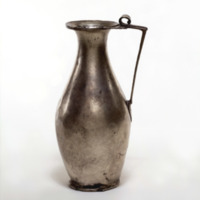
Museum Desciprtion: “This silver ewer reflects the good life that could be found in a household in Daphne, the wealthy suburb of the great commercial city of Antioch. In one of the villas, the ewer was discovered purposely buried together with three…
Solidus of Constantine I
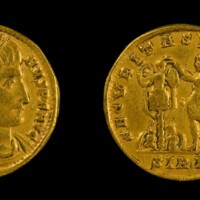
Obverse Bust of Constantine to r., laureate, draped and cuirassed
Inscription: CONSTANTINVS P F AVG
CONSTANTINVS P[IVS] F[ELIX] AVG[VSTUS]
Constantine Dutiful and Wise Augustus
Reverse Emperor standing crowning trophy
Inscription:…
Inscription: CONSTANTINVS P F AVG
CONSTANTINVS P[IVS] F[ELIX] AVG[VSTUS]
Constantine Dutiful and Wise Augustus
Reverse Emperor standing crowning trophy
Inscription:…
Christ as Sol Invictus
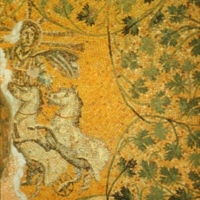
This ceiling mosaic in Mausoleum M, the Tomb of the Julii, in the Vatican Necropolis underneath St. Peter’s Basilica, has been interpreted as depicting Christ as Sol Invictus (Unconquered Sun), the sun god of the later Roman Empire. Sol Invictus came…
Roundel
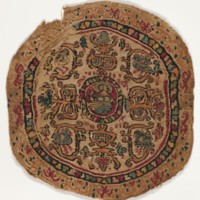
Museum Description: “Tapestry woven roundel (orbiculus). The small medallion at its center contains a female figure, likely a beneficent personification, with a green nimbus against a bright red background. Her breasts are distinguished in yellow…
Griffin’s Head Lamp
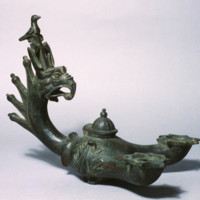
Museum Description: “Noteworthy for its imposing size, this lamp is also remarkable for its combination of pagan and Christian imagery. The handle is an elegantly articulated griffin’s head, which derives from pagan mythology, while the cross, symbol…
Keystone with Dionysos
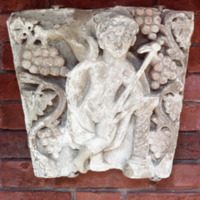
Museum Description: “The fragment (BZ.1940.60) showing Dionysus, nude except for a mantle, with legs crossed and his right arm placed over his head—now broken off—leaning on a spirally fluted pedestal, served as a keystone of an arch whose span would…