Browse Items (20 total)
- Collection: Late Antiquity, Seminar 1
Sort by:
Solidus of Justinian I
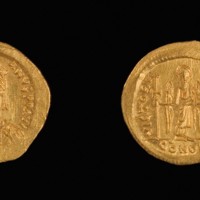
Obverse Inscription: DNIVSTINI ANVSPP
D(ominus) N(oster) Iustinianus P(er) P(etuus) AVG(ustus) ("Our Lord Justinian, Eternal Emperor").
A frontal bust portrait of the emperor wearing a helmet, diadem, and cuirass. In his hand is a globus…
D(ominus) N(oster) Iustinianus P(er) P(etuus) AVG(ustus) ("Our Lord Justinian, Eternal Emperor").
A frontal bust portrait of the emperor wearing a helmet, diadem, and cuirass. In his hand is a globus…
Seuso Platter
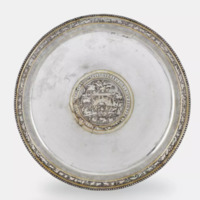
The Seuso Platter is one of the 14 silver objects that make up the Seuso Treasure. This hoard of late Roman silver was at the center of decades worth of debate in the international art market, stemming from falsified documentation with regards to the…
Pilgrim Flask with Scenes of St. Menas
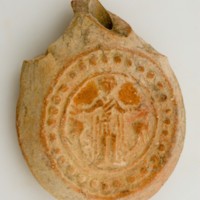
Museum Commentary: “Flasks bearing images of Saint Menas are not uncommon in Egypt. Menas was a Roman soldier who was martyred; veneration of him as a saint centered on an oasis near Alexandria. On better-preserved ampullae bearing the same scene,…
Necklace with Pendant of Aphrodite Anadyomene
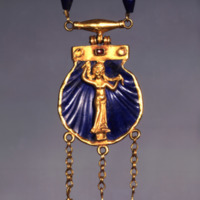
Museum Description: "Standing in a blue shell, Aphrodite Anadyomene wrings seawater from her hair. The pose was well known in antiquity, referring to the goddess’s birth from the sea, of which the deep blue color of the lapis lazuli is a visual…
Mummy Portrait of a Man
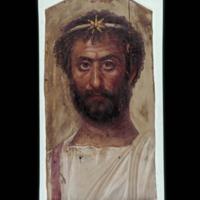
Museum Description: “Portrait, perhaps of a priest, in encaustic on limewood: the panel is cracked through the right side from the upper edge to the subject's proper left ear. A row of four nail holes indicative of reuse, or perhaps of attachment to…
Medicine Box with Hygieia
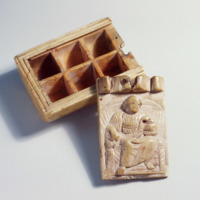
Museum description: “Most ivory and bone containers are really wooden, covered with veneers of ivory. This craftsman chose the more extravagant option of carving the box with its six compartments out of a solid block of ivory, the rounded back…
Madaba Map
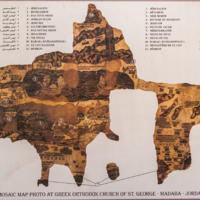
The Madaba Map is a floor mosaic that contains the oldest surviving cartographic depiction of the Holy Land. It dates to the 6th century and is found at the Church of Saint George in Madaba, Jordan. The presence and absence of various monuments has…
Laocoön and His Sons, Vatican Vergil
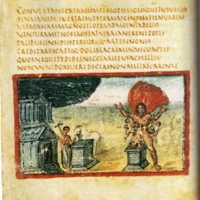
The Vatican Vergil, which contains fragments of Vergil’s Aeneid and Georgics, is one of three surviving illustrated manuscripts of classical literature along with the Vergilius Romanus and the Ambrosian Iliad. Today, the Vatican Vergil consists of 76…
Icon of Christ and Abbot Mena
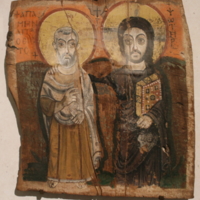
Museum information: “This exceptional painting on wood comes from the monastery of Bawit in Middle Egypt. Dated to the 8th century, it represents Christ (easily recognizable by his halo with a cross) and Abbot Mena, the superior of the monastery at…