Laocoön and His Sons, Vatican Vergil
Dublin Core
Title
Laocoön and His Sons, Vatican Vergil
Subject
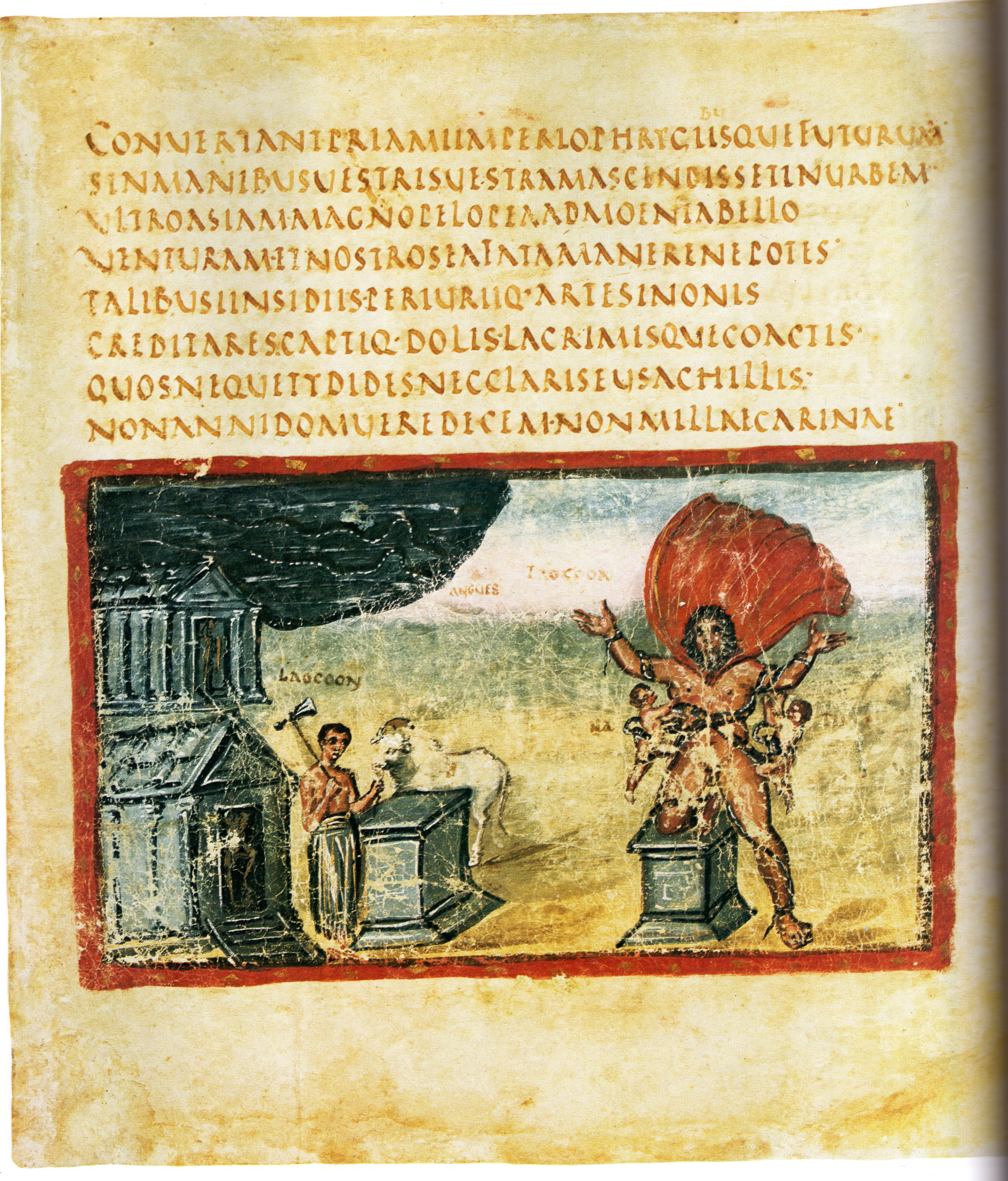
Fol. 18v, MSCod. Vat. Lat. 3225, “The Death of Laocoön” from the Vatican Vergil (Vergilius Vaticanus), c. 400 CE, Roman, Vatican, Biblioteca Apostolica.
Description
The Vatican Vergil, which contains fragments of Vergil’s Aeneid and Georgics, is one of three surviving illustrated manuscripts of classical literature along with the Vergilius Romanus and the Ambrosian Iliad. Today, the Vatican Vergil consists of 76 leaves with 50 illustrations, but could have originally had about 440 leaves and 280 illustrations. Scholars have identified three different painters, whose artistic quirks and styles are evident throughout their respective work throughout the codex. Conversely, it is thought that almost all of the text (written in capitals with no spaces between words), was written by a single scribe.
Text (Aeneid, Book II, lines 191-198):
“…[(quod di prius omen in ipsum]
convertant!) Priami imperio Phrygibusque futurum;
sin manibus vestris vestram ascendisset in urbem,
ultro Asiam magno Pelopea ad moenia bello
venturam, et nostros ea fata manere nepotes.'
Talibus insidiis periurique arte Sinonis
credita res, captique dolis lacrimisque coactis
quos neque Tydides nec Larisaeus Achilles,
non anni domuere decem, non mille carinae."
“…[(may the gods first turn that prediction on]
themselves!) would come to Priam and the Trojans:
yet if it ascended into your citadel, dragged by your hands, Asia would come to the very walls of Pelops, in mighty war, and a like fate would await our children. Through these tricks and the skill of perjured Sinon, the thing was credited, and we were trapped, by his wiliness, and false tears, we, who were not conquered by Diomede, or Larissan Achilles, nor by the ten years of war, nor those thousand ships.
-Trans. A. S. Kline
Text (Aeneid, Book II, lines 191-198):
“…[(quod di prius omen in ipsum]
convertant!) Priami imperio Phrygibusque futurum;
sin manibus vestris vestram ascendisset in urbem,
ultro Asiam magno Pelopea ad moenia bello
venturam, et nostros ea fata manere nepotes.'
Talibus insidiis periurique arte Sinonis
credita res, captique dolis lacrimisque coactis
quos neque Tydides nec Larisaeus Achilles,
non anni domuere decem, non mille carinae."
“…[(may the gods first turn that prediction on]
themselves!) would come to Priam and the Trojans:
yet if it ascended into your citadel, dragged by your hands, Asia would come to the very walls of Pelops, in mighty war, and a like fate would await our children. Through these tricks and the skill of perjured Sinon, the thing was credited, and we were trapped, by his wiliness, and false tears, we, who were not conquered by Diomede, or Larissan Achilles, nor by the ten years of war, nor those thousand ships.
-Trans. A. S. Kline
Source
https://digi.vatlib.it/view/MSS_Vat.lat.3225
Files
Collection
Citation
“Laocoön and His Sons, Vatican Vergil,” HAA Image Hosting, accessed August 23, 2026, https://haaimagehosting.omeka.fas.harvard.edu/items/show/281.
Embed
Copy the code below into your web page