Hanging with Hestia Polyolbus
Dublin Core
Title
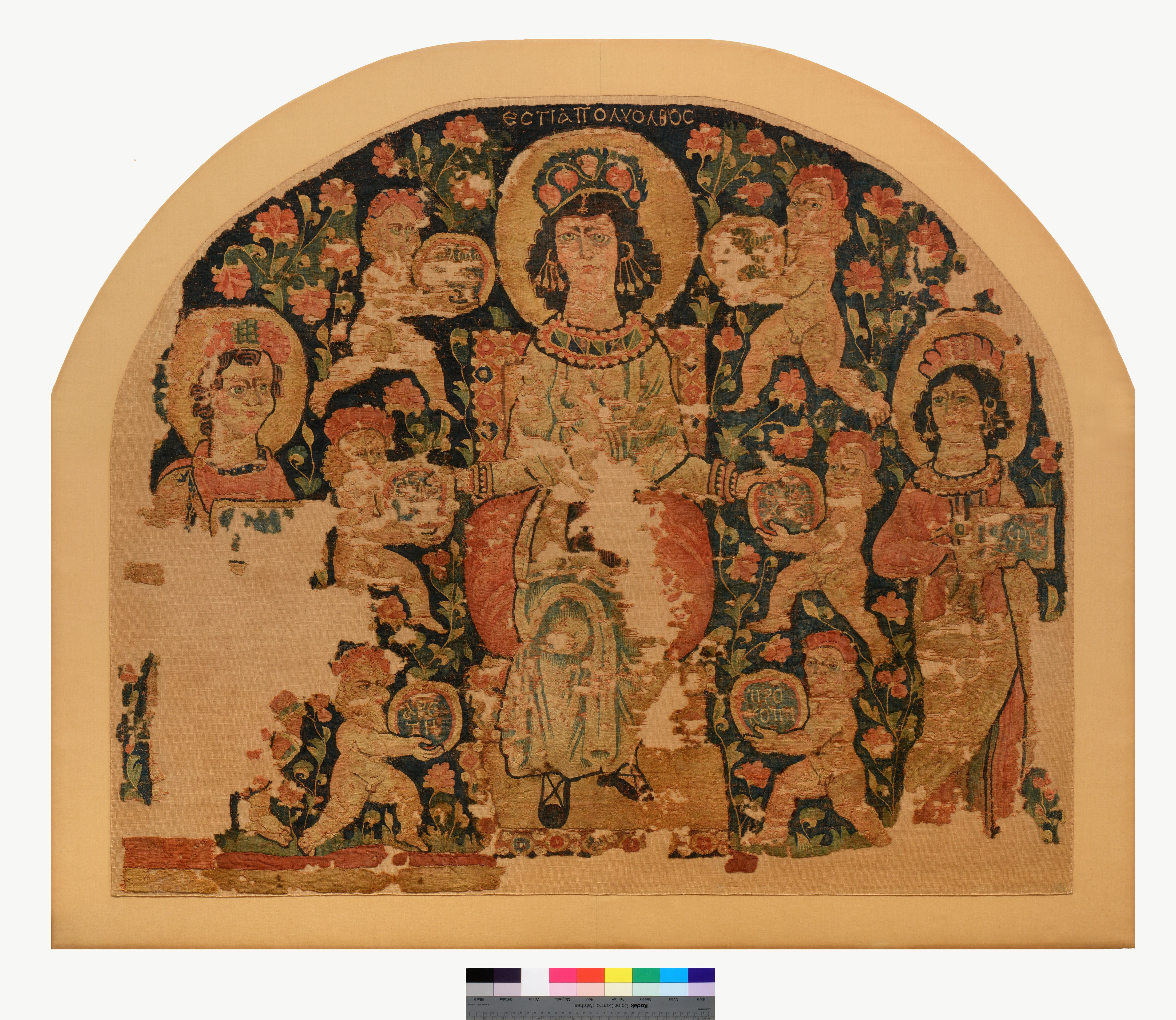
Hanging with Hestia Polyolbus
Subject
Hanging with Hestia Polyolbus, Early Byzantine, c. 6th century, 138 x 114.5 cm, wool, Washington D.C., Dumbarton Oaks.
Description
Museum Description: "This tapestry excited scholarly interest immediately after the Blisses acquired it in 1929. They lent it in 1931 to the first major exhibition of Byzantine art in Paris where, according to Royall Tyler, the French art historian Paul Alfassa “proclaimed that it beat all of the Gothic tapestries in the world into a cocked hat.” Within ten years it had been published as many times.
Hestia Polyolbos (Hestia, full of blessing) distributes blessings from her throne, assisted by six winged genii, each carrying a disc naming a blessing; euphrosyne (“mirth”), euochia ( “good cheer”), prokope (“prosperity”), ploutos ( “wealth”), eulogia (“blessing”), and arete (“virtue”). Two other regal figures frame the group, one labeled phos (“light”).
Hestia, the Greek noun for hearth, is also the name of the goddess of the household hearth. Our knowledge of her cult is vague, partly because she was venerated, not at a few localized shrines, but wherever fires were found. It may be for this reason that hymns give her a universal character as the center of the world and the house of the gods. Hestia’s removal from any narrative context, when combined with her frontal pose and the laudatory epithet Polyolbos, suggests that this image was a focus for worship, one that deviated from the Greek tradition of cult statues. A salient difference is that while worshipers can escape the gaze of a cult statue by moving, the flatness of a tapestry allows Hestia’s eyes to follow the devout anywhere they move. This potency of two-dimensional images to conjure up a commanding presence was exploited at this time, both by the last phases of traditional Olympian religion and by the contemporary early phase of Christianity."
J. Hanson
Hestia Polyolbos (Hestia, full of blessing) distributes blessings from her throne, assisted by six winged genii, each carrying a disc naming a blessing; euphrosyne (“mirth”), euochia ( “good cheer”), prokope (“prosperity”), ploutos ( “wealth”), eulogia (“blessing”), and arete (“virtue”). Two other regal figures frame the group, one labeled phos (“light”).
Hestia, the Greek noun for hearth, is also the name of the goddess of the household hearth. Our knowledge of her cult is vague, partly because she was venerated, not at a few localized shrines, but wherever fires were found. It may be for this reason that hymns give her a universal character as the center of the world and the house of the gods. Hestia’s removal from any narrative context, when combined with her frontal pose and the laudatory epithet Polyolbos, suggests that this image was a focus for worship, one that deviated from the Greek tradition of cult statues. A salient difference is that while worshipers can escape the gaze of a cult statue by moving, the flatness of a tapestry allows Hestia’s eyes to follow the devout anywhere they move. This potency of two-dimensional images to conjure up a commanding presence was exploited at this time, both by the last phases of traditional Olympian religion and by the contemporary early phase of Christianity."
J. Hanson
Source
http://museum.doaks.org/objects-1/info/27440
Publisher
Dumbarton Oaks. BZ.1929.1
Files
Collection
Citation
“Hanging with Hestia Polyolbus,” HAA Image Hosting, accessed October 1, 2026, https://haaimagehosting.omeka.fas.harvard.edu/items/show/291.
Embed
Copy the code below into your web page