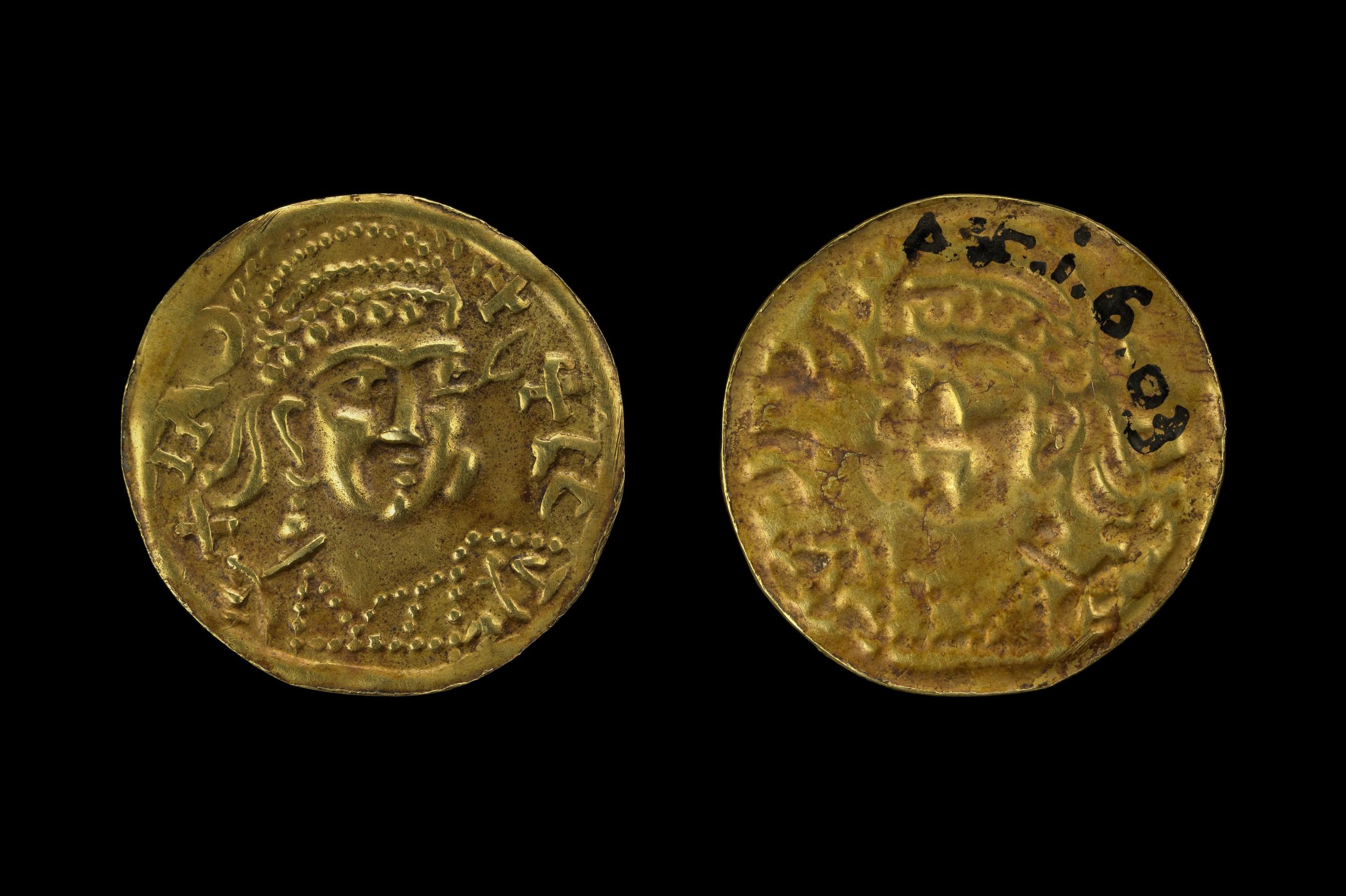
Gold uniface imitation of Byzantine gold coin.Three-quarter face bust of Anastasios or Justinian I. Minted/created in China: Xinjiang
Dublin Core
Title
Gold uniface imitation of Byzantine gold coin.Three-quarter face bust of Anastasios or Justinian I. Minted/created in China: Xinjiang
Subject
6th c, Xinjiang, gold, 0.85 g, British Museum
Description
Uniface imitation of Byzantine gold coin. (whole)
Blank. (reverse)
Three-quarter face bust of Justinian I. (obverse)
Curator's comments
Stein 1928, p.646: "The fact that out of the four coins actually found by us in the mouths of Astana corpses three are Byzantine gold pieces or imitations of such pieces (Ast.i.3.023; Ast.i.5.08; Ast.i.6.03) and one a Sasanian silver coin (Ast.v.2.02) might naturally predispose us to connect this practice with the ancient Greek custom of placing a coin between the lips of the dead as the fare to Charon, the ferryman of Hades. But the reference with which M. Chavannes kindly supplied me in 1916 to a Buddhist story in the Chinese Tripitaka suggests that the custom was not unknown in the Far East also. [fn4: See Chavannes, Cinq cents contes et apologues extraits du Tripitaka chinois, i, p.248] It must further be borne in mind that as China had never had a gold or silver coinage, those who at Turfan wished to provide their dead with an adequate obolus for the journey to the world beyond would necessarily have to use a coin of Western origin for their pious purpose, if they wished it to be of precious metal."
Stein 1928, p.649: ""From the head of the other body, (b), which may have been that of a woman, was recovered the fragmentary face-cover of polychrome figured silk, Ast.i.6.01, showing 'Sasanian' pattern with a boar's head and pearl border, similar to Ast.i.5.03 (Pl.LXXVI), but smaller. Underneath was found the pair of silver spectacles, Ast.i.6.07 (Pl.LXXXIX). The mouth of (b) held a thin gold coin (Pl.CXX), struck on one side only, showing the three-quarter face bust of Justinian I, as it appears on the Byzantine coins of which this and the gold pieces from Ast.i.3 and Ast.i.5 are undoubtedly imitations. Two Wu-zhu [pinyin: wuzhu] coins, in perfect condition, were found near the head of (b)."
Blank. (reverse)
Three-quarter face bust of Justinian I. (obverse)
Curator's comments
Stein 1928, p.646: "The fact that out of the four coins actually found by us in the mouths of Astana corpses three are Byzantine gold pieces or imitations of such pieces (Ast.i.3.023; Ast.i.5.08; Ast.i.6.03) and one a Sasanian silver coin (Ast.v.2.02) might naturally predispose us to connect this practice with the ancient Greek custom of placing a coin between the lips of the dead as the fare to Charon, the ferryman of Hades. But the reference with which M. Chavannes kindly supplied me in 1916 to a Buddhist story in the Chinese Tripitaka suggests that the custom was not unknown in the Far East also. [fn4: See Chavannes, Cinq cents contes et apologues extraits du Tripitaka chinois, i, p.248] It must further be borne in mind that as China had never had a gold or silver coinage, those who at Turfan wished to provide their dead with an adequate obolus for the journey to the world beyond would necessarily have to use a coin of Western origin for their pious purpose, if they wished it to be of precious metal."
Stein 1928, p.649: ""From the head of the other body, (b), which may have been that of a woman, was recovered the fragmentary face-cover of polychrome figured silk, Ast.i.6.01, showing 'Sasanian' pattern with a boar's head and pearl border, similar to Ast.i.5.03 (Pl.LXXVI), but smaller. Underneath was found the pair of silver spectacles, Ast.i.6.07 (Pl.LXXXIX). The mouth of (b) held a thin gold coin (Pl.CXX), struck on one side only, showing the three-quarter face bust of Justinian I, as it appears on the Byzantine coins of which this and the gold pieces from Ast.i.3 and Ast.i.5 are undoubtedly imitations. Two Wu-zhu [pinyin: wuzhu] coins, in perfect condition, were found near the head of (b)."
Files
Collection
Citation
“Gold uniface imitation of Byzantine gold coin.Three-quarter face bust of Anastasios or Justinian I. Minted/created in China: Xinjiang,” HAA Image Hosting, accessed October 7, 2026, https://haaimagehosting.omeka.fas.harvard.edu/items/show/1433.
Embed
Copy the code below into your web page