Browse Items (972 total)
Sort by:
Glass jar with marvered trails
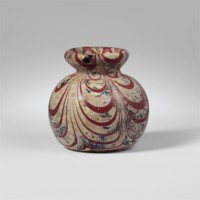
Uncertain translucent color; trail and pontil pad in opaque brownish red.
Thick, outsplayed rim, folded over, in, and pressed down into mouth; very short, concave, cylindrical neck; globular body; kick in bottom, with traces of pontil…
Thick, outsplayed rim, folded over, in, and pressed down into mouth; very short, concave, cylindrical neck; globular body; kick in bottom, with traces of pontil…
Glass Jug
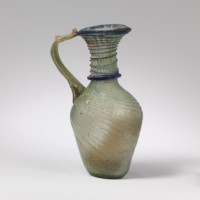
Translucent blue green; handle in same color; trails in translucent cobalt blue.
Plain rim, with downward flange on one side; flaring mouth; cylindrical neck, expanding slightly downwards; slanting, rounded shoulder; funnel-shaped body; thick bottom…
Plain rim, with downward flange on one side; flaring mouth; cylindrical neck, expanding slightly downwards; slanting, rounded shoulder; funnel-shaped body; thick bottom…
Gold Aureus of Emperor Constantine I, minted in Sirmium (modern Sremska Mitrovica, Serbia)

Bust of Constantine I, draped, cuirassed, head, laureate, right. (obverse). Sol, radiate, naked except for cloak over both shoulders, standing right, crowning, with raised right hand, Constantine I, in military dress, with cloak over both shoulders,…
Gold Bar
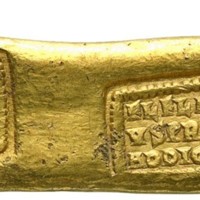
This gold bar is one of fifteen (all dating to the 4th century) that were found in Romania in the late 19th century. The form makes it more easily transportable, and it most likely would have been brought to a mint where it would have been melted…
Gold Chain with Fifty-Two Pendants

This gold necklace was found in Szilágysomlyó (modern-day Simleu-Silvaniei, Romania) in 1797 by two shepherd boys. The central pendant is smoky quartz. The other 51 pendants depict various tools and weapons in miniature as well as a man in a canoe.…